THE EXHIBITIONS
The two exhibitions run in parallel and are conceived as a conversation across generations, bringing together Jagoda Buić – Beyond Tapestry from the Foundation’s collection, and a newly commissioned work by invited artist Lala Raščić – A SMILE, SMIRK, SNEER, SNICKER (or teeth as language).
Jagoda Buić was a central figure in the international fiber art movement. From the 1960s onward, she redefined tapestry as a sculptural and spatial medium, exhibiting at the Lausanne International Tapestry Biennials, the Bienal de São Paulo, and the Biennale Arte in Venice.
For its inaugural exhibition, the Foundation focuses on the contemporary art scene of Bosnia and Herzegovina, where, in the late 1970s, Jagoda Buić created several public tapestry commissions, including the main theatre curtain for the Bosnian National Theatre Zenica (1977) and a monumental tapestry installation Black Leafing (1978) for the Electric Utility of Bosnia and Herzegovina in Sarajevo, both still on view.
As an homage – yet in her own artistic language – Lala Raščić engages with Buić’s tapestry in her hometown of Sarajevo, translating its relief structures into patterns on glass within a multi- sensory, lumino-kinetic installation of verre églomisé elements that evoke the ambiguity of the Gorgoneion smile.
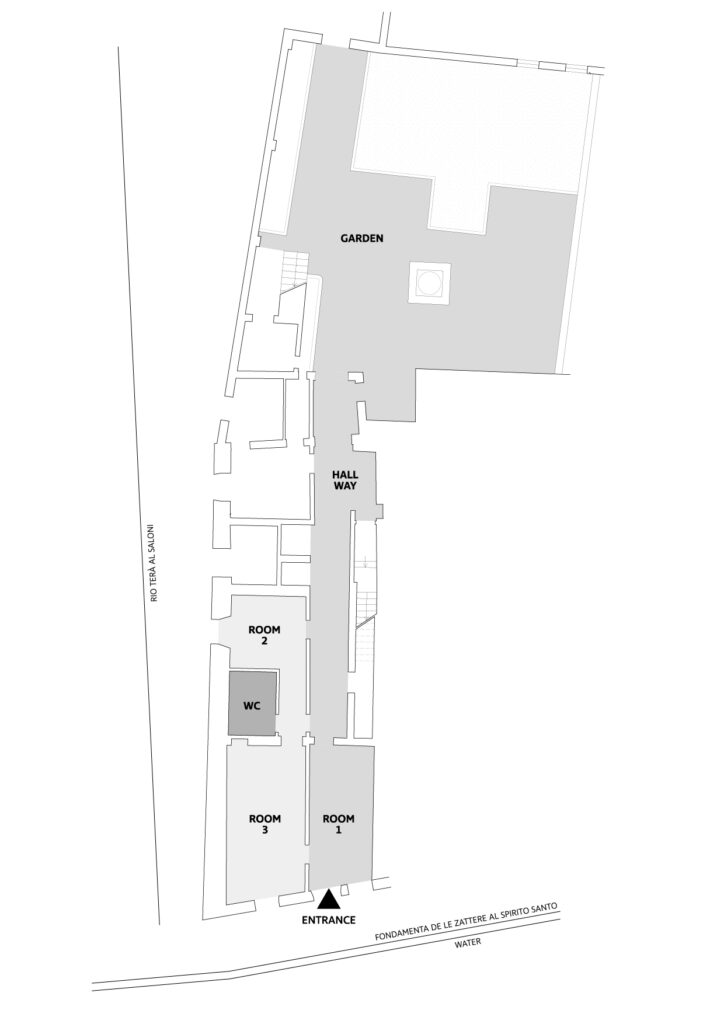
Jagoda Buić: Room 1, Hallway, Garden
Lala Raščić: Room 2, Room 3
JAGODA BUIĆ
BEYOND TAPESTRY
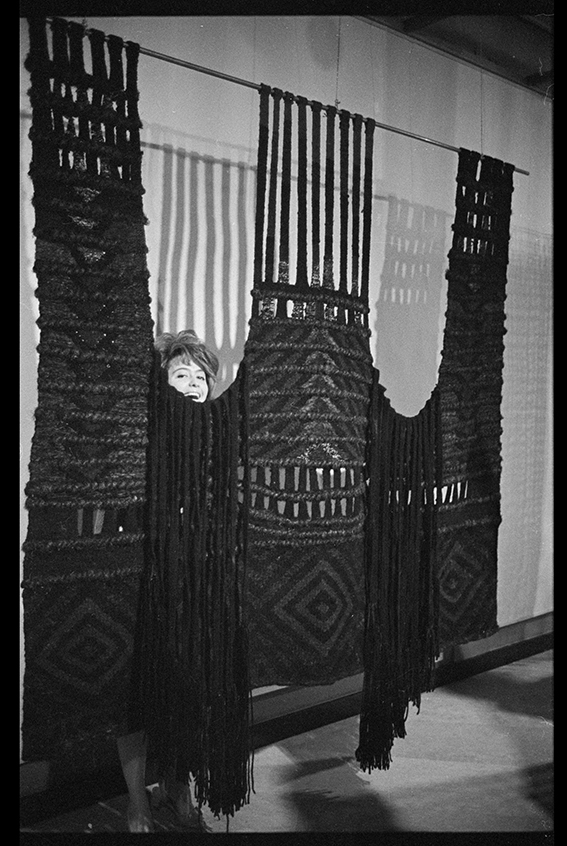
Jagoda Buić, Fallen Angel, 1967. Exhibition at Lausanne Town Hall, 1967.
© Photo Elysée, Lausanne, Fonds Marcel Imsand
Beyond Tapestry presents a cross-section of Jagoda Buić’s work from the Dr. Hans Wuttke Foundation collection, accompanied by archival video documentation. Conceived as a series of “snapshots”, it traces her artistic development across her studios in Zagreb, Dubrovnik, and Bonnieux. The title refers both to Buić’s expansion of tapestry beyond its traditional meaning and function and to the exhibition selection, which includes sculptures, works on paper, and a personal object – decorative strawberries collected by the artist as a self-referential gesture alluding to the meaning of her name.
The exhibition’s centerpiece, Rhythmised Form (1977), is a modular work in two parts. It can be displayed on a wall, as in the exhibition, or installed as a woven sculpture when joined with its second part, demonstrating its formal flexibility. It belongs to a body of work developed in collaboration with women weavers from the Sandžak region in the 1970s, drawing on traditional weaving practices while, as she stated, aiming “to infuse tradition with the impulse of contemporary issues”.
– Buić, 1976
Archival footage from 1968 captures the artist at work in her Zagreb studio, where she began exploring tapestry beyond the wall, developing spatial forms and experimenting with weaving techniques. Her time in Zagreb as a student at the Academy of Applied Arts brought her into contact with the ideas of EXAT 51, whose advocacy of abstraction and the integration of fine and applied arts with architecture would later inform her expansion of tapestry.
Selected works on paper range from late 1960s tapestry sketches to more autonomous drawings from the 1980s, at times reflecting a sculptural mode of thinking. As the artist said:
“I’ve always had a very pronounced sculptural note throughout my work – starting from scenography onward. By nature, I’m more of a sculptor than a painter”.
– Buić, 1991
The colorful Hommage à l’Apocalypse (1991) responds to the war in the former Yugoslavia. This period marked the end of her collaboration with women weavers and a turning point in her practice, leading to a focus on paper collages in the following decade.
In her later years in Bonnieux in southern France, Buić created the series Scherzo from Waste (2016), welding discarded metal fragments into collages. Like her paper collages – made “directly from the hand and as quick as thought” – these works assemble fragments into new forms, where meaning emerges through naming. As she put it:
“This is not an objet trouvé, but a free-form collage of scrap iron. A game. A joke”
– Buić, 2016.
Presented in Venice, the exhibition reconnects the artist with a city that shaped her life and career from her student days onward. Later, Venice became her home, where she spent her final years, the city remaining a constant source of inspiration. In her own words:
“When I was very young, I used to say, ‘Venice, c’est une maladie!’ Venice is a disease. In a way, you become infected by Venice. I tell you; Venice isn’t a city – it’s a disease. Yet Venice is always irresistibly inspiring; not a single moment in Venice is indifferent.”
– Buić 2006.
ARTIST STATEMENT
SCHERZO FROM WASTE
THIS IS NOT AN “OBJET TROUVÉ” – IT IS A
FREE-FORM COLLAGE MADE OF
SCRAP IRON.
A GAME. A JOKE.
IT WILL ONLY TRY TO ENTER THE REALM OF ART
THROUGH ITS PORTRAIT.
IF IT DOESN’T SUCCEED, MY MESSAGE REMAINS:
THERE IS NO DISCARDED OBJECT THAT WON’T
FIND ITS PLACE SOMEWHERE.
WHEN I ASSEMBLE A FEW PIECES OF ANYTHING,
I GET SOMETHING.
ONLY WHEN I GIVE IT A NAME DOES IT
BECOME SOMETHING.
WHY?
BECAUSE OF ALLUSION.
BECAUSE OF IMAGINATION.
BECAUSE OF ILLUSION.
“THE OBJECT AND ITS PORTRAIT” IS A LYRICAL
ESSAY WHERE THE SADNESS OF ABANDONMENT
AND THE DESPAIR OF USELESSNESS MEET
THE JOY OF THE CREATIVE ACT AND
CHEERFUL IRONY.
(THE OBJECT WILL GAIN ITS “STATUS” ONLY
THROUGH THE PORTRAIT, IF THE AUTHOR
SUCCEEDS IN THIS.
A STEP INTO THE UNKNOWN.)
JB, 2016
Exhibition Credits
Curator: Ivana Čuljak
Text editing and proofreading: Jelena Primorac
Archives: Alice Pauli Gallery Archives, Audiovisual Archive of Croatian Radiotelevision, CITAM Archives, Photo Elysée – Marcel Imsand Fonds, Paris Musées Archive
Graphic design: Pentagram Berlin

LALA RAŠČIĆ
A SMILE,
SMIRK,
SNEER,
SNICKER,
(or teeth as language)
But the most important of all human features for the grotesque is the mouth. It dominates all else. The grotesque face is actually reduced to the gaping mouth; the other features are only a frame encasing this wide-open bodily abyss.
– Mikhail Bakhtin
The new artistic production A SMILE, SMIRK, SNEER, SNICKER (or teeth as language) by artist Lala Raščić continues her ongoing exploration of the Gorgon motif. Her work is centered on the figure of Medusa (1), presented in myth as a being whose gaze turns others to stone, while her face – with its gaping mouth, piercing stare and snakes instead of hair – stands out as one of the most striking emblems of ancient iconography (2). As an apotropaic sign that appears in architecture, on shields and everyday objects, it functions as a grotesque, protective face that repels evil with its gaze.
Starting from the archaic Greek depiction of the Gorgoneion, liberated from its narrative and cultural context, the artist further deconstructs and stylizes the motif, shifting the focus to the smile as an ambivalent sign that maintains the tension between attraction and apprehension. Here, the smile appears as an element stripped of its psychological and social function, reduced to its own materiality. Isolated from the face as whole, it loses stability and its function of a sign that signifies. With further stylization the artist moves onto the mouth, into the oral cavity, where teeth are treated as a site for the production of meaning and a place where meaning manifests as a bodily expression.
The exhibition narrative unfolds through a series of interwoven, yet, media- and performance-wise, distinct segments, including a time-based installation, sound, sculpture and drawing. The central part consists of a lumino-kinetic installation composed of suspended glass elements of various sizes and shapes arranged in a unified horizontal composition. Each element is fabricated with precision and subsequently visually articulated by Raščić in verre églomisé, a gilding technique where precious metal leaves are applied to glass. The surfaces are partially filled with gold and silver tones, with linear and ornamental details emphasizing their organically shaped forms. These fragmented depictions of the jaw dismantle the unity of the hypothetical body and introduce it to a state of dispersion, whereby recognizable forms transform into open, multiplied and spatially scattered elements. Reflections and refractions of light alter the way these glass elements are perceived, making them simultaneously present and displaced, while the relationship between viewer and space is constantly reshaped.
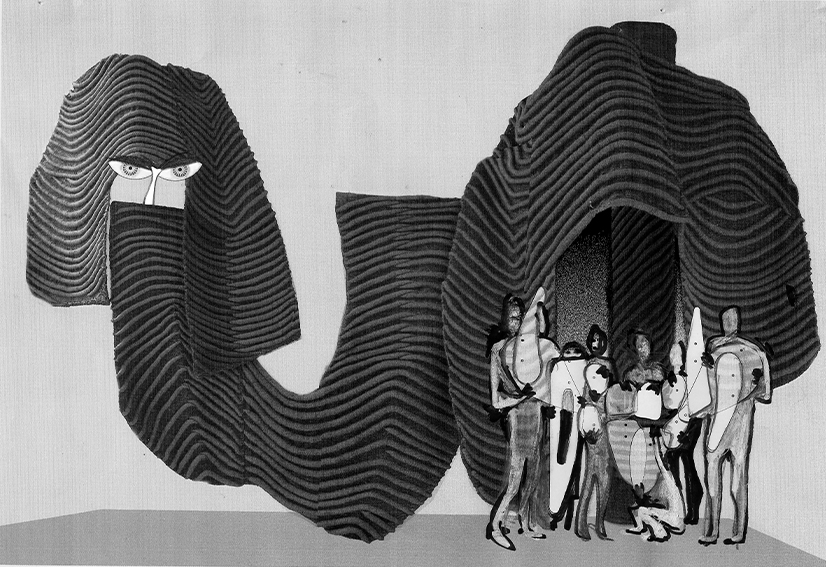
An important structural element of the installation is also the homage to Jagoda Buić, visible through abstract patterns taken from her monumental tapestry Crno Listanje (Black Leafing) (3), in which Raščić recognizes a rhythm of layers that is almost repetitive, yet not controlled. Extracted and enlarged details of ribbed textures, present through shadows rather than reflection, visually and symbolically enhance the unified glass composition. The ambiental soundscape further intensi(es the spatial dynamics of the installation, transforming it into a comprehensive experience emerging from the sensory interplay of space, light and sound.
The sculpturally treated dental prosthetic object, based on the cast of the artist’s own mouth, is introduced as an autonomous object that simultaneously evokes the body and departs from it. Certain teeth are enlarged and morphologically deformed, removed from sequence, coated in gold or shaped in ceramic, disrupting their mutual harmony. In such reorganization, the dental form separates from anatomy and abandons its original function. The presentation of the object in the exhibition space introduces an additional symbolic dimension: placed on a pedestal, precisely lit and enclosed under a glass dome, the object belonging to prosthetic dentistry takes on the character of a relic – protected and emphasized in its presence.
The exhibited drawings, apart from serving as documentation of the creative process, also function as connective tissue between installation and object, where forms of the jaw and the teeth are continuously examined and reshaped. The line is rapid, restless and repeatedly drawn. Form is constructed through overlaps, repetitions and variations, as an action based on the relationships between line, volume and rhythm.
Through stylization, fragmentation and deformation of form, Lala Raščić builds layered compositions that move between the recognizable and the abstract, between the attractive and the repulsive. Teeth thus become carriers of meaning, while variations of the smile – from restrained to mocking – open a space in which meaning continues to transform. This orientation toward the body can be read in relation to Hélène Cixous’s essay The Laugh of the Medusa (1975), one of the reference points of this work. For Cixous, meaning is not transmitted but established through the body, its fragmentation and exposure. The smile no longer remains in the function of a sign but appears as an unstable form that escapes fixation.
In this instability, the body is no longer a closed whole but unfinished and permeable, in constant becoming – corresponding to what Mikhail Bakhtin defines as the grotesque body . Within such a body, death and renewal, destruction and birth appear as inseparable moments of the same cycle. Its boundaries are most clearly manifested in the motif of the mouth and teeth, at the site where exchange between interior and exterior, body and world takes place. Fragmented and isolated elements of the gaping mouth continue this logic of openness. In this work, the grotesque functions as an operative principle structuring both its conceptual-content level and its constructive-formal framework, encompassing in its ambivalence both poles of change – old and new, destruction and creation. Its effect is evident in the dismantling of established relations and the formation of new connections, opening the possibility of a different order beyond the apparent stability of the existing. The grotesque principle employed by Raščić affirms that the only constant is change.
A SMILE, SMIRK, SNEER, SNICKER (or teeth as language) is a layered artistic project in which the artist symbolically rounds off her long-term exploration of the Medusa myth. The work develops through various media – from drawings, through object, to installation – in which the motifs of the jaw and teeth are fragmented, abstracted and spatially organized, while the form simultaneously functions as a bearer of content and as a creative principle that shapes all the parts into a coherent whole. The technical realization of the work is based on precise and complex processing of various sensitive materials, involving a series of carefully controlled interventions. The final form emerges in the very act of processing, through which the work with the material acquires a performative character. The precision of craftsmanship and the quality of execution confirm Lala Raščić’s technical virtuosity and her confident command of different media.
The work is conceived in direct relation to the architectural heritage and the space of Casa Jagoda Buić in Venice – Buić’s final residence – which opens as an exhibition space for the first time with this presentation. The presence of Buić’s works in this environment functions not merely as an institutional framework, but as an open dialogue between two poetics and two distinct artistic styles: three-dimensional textile structures on one side, and fragmented, reflective forms on the other. In this interaction, the exhibition becomes a meeting point of different artistic media, styles and temporal layers, where meanings are constantly reestablished.
Exhibition Credits
Production assistant: Luana Lojić
Studio assistant: Ana Dutina
Text and curatorial consulting: Anja Bogojević
Creative technical solutions and programming: Branimir Štivić
Dental prosthetics fabrication: Mekić Dent Art, Sarajevo
Sound design: Hrvoje Nikšić
Text editing and proofreading: Giulia Crisci, Timothy Weeks
Thank you: Christopher Alfieri • Prof.dr.sci. Emir Berhamović • Nemanja Cvijanović • Denali Art Solutions • Tin Dožić • Andreja Dugandžić • Elektroprivreda BiH d.d. Sarajevo • Jasna Jakšić • Prof.dr.sci. Alma Konjhodžić • Miroslav Kružik • Faruk Mehmedović • Lorenzo Perini • Miloš Trakilović • Mima Zukan
Commissioned by: Dr. Hans Wuttke Foundation
Curator: Ivana Čuljak
Graphic design: Pentagram Berlin
1) Lala Raščić’s artistic practice unfolds through intermedial formats (performance, video, installation, objects, drawings, etc.), within which the artist systematically explores the relationships between narrative, the body and cultural patterns. Her work originates from an interest in ancient mythology, South Slavic folk heritage and historical models of storytelling, which she subjects to critical reading and reinterpretation from feminist and postcolonial perspectives, thereby questioning dominant structures of knowledge, representation and authority. This approach is evident in a series of projects dedicated to the figure of Medusa and related mythological motifs, such as Frau Ritter (2024), The Laugh of the Medusa (2022), EE-0 (2021), Gorgo (2019–2021), The more tongues you silence, the more they talk (2021), The Eumenides (2014–2018), among others.
2) According to Greek mythology, Medusa was one of the three Gorgon sisters and the only mortal among them, known for turning her victims to stone with her gaze. There are several versions of this myth, the most widespread being the one recorded by Ovid in Metamorphoses, according to which Medusa was an exceptionally beautiful maiden who was raped by Poseidon in the temple of Athena, the goddess of wisdom. As punishment for the desecration of her temple, Athena transformed her into a monster with snakes instead of hair and a petrifying gaze. In later versions of the Medusa myth, the central role is taken by Perseus, who, with the help of the reflection in a bronze shield, beheads her. From her body sprang the winged horse Pegasus, while her head retained its power and was placed on Athena’s shield as a protective emblem, the Gorgoneion.
3) The tapestry Crno Listanje (Black Leafing), 1978, by Jagoda Buić is located in the building of the Electric Utility of Bosnia and Herzegovina (Elektroprivreda BiH d.d.) in Sarajevo, which was designed in the same year by the Bosnian- Herzegovinian architect Ivan Štraus.
4) Bakhtin, Mikhail. Rabelais and His World. Translated by Helene Iswolsky. Bloomington: Indiana University Press, 1984